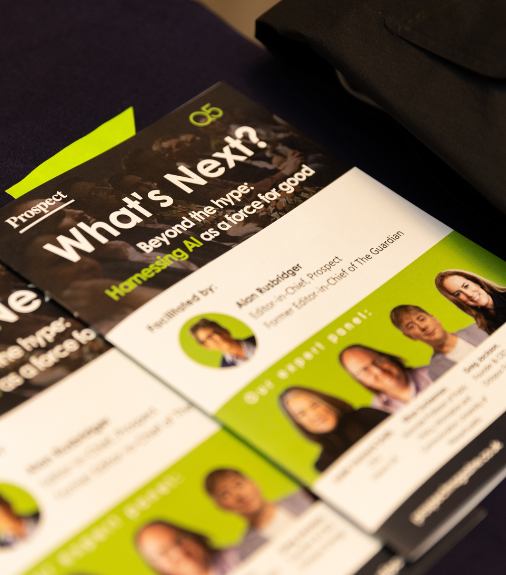
Beyond the AI hype: A summary of our recent panel discussion
Amidst ongoing concern surrounding AI risk, safety, and ethics, a key question arises: How can we truly harness this powerful technology as a force for good? To answer this, our recent ‘What’s Next?’ event provided an invaluable forum.
Reading time: 2 minutes
It’s time to look beyond the Artificial Intelligence (AI) hype
Last year, as AI-mania took hold, thousands of .ai businesses looking to leverage AI registered thousands of .ai domains (a boon for the Anguillan economy).
Over that period, every business under the sun started running experiments, claiming to be ‘powered by AI,’ or banning their employees from even mentioning ChatGPT.
Even with all the buzz, real-world uses of AI in business remain limited. Only started using generative AI solutions in 2023. The slow adoption is down to the technology still evolving. The IBM Global Adoption Index says that not having the right skills to use and manage trustworthy AI is a big problem.
Amidst ongoing concern surrounding AI risk, safety and ethics, a key question arises. How can we truly harness this powerful technology as a force for good? To answer this, our recent ‘What’s Next?’ event provided an invaluable forum.
In partnership with Prospect Magazine, the ‘What’s Next?’ series invites industry experts to discuss important challenges and events. These discussions focus on what is shaping the future of business.
Through a platform that was most fitting for the topic, it was fantastic to listen to our distinguished panel discuss the subject of ‘harnessing AI as a force for good. The experts delved into actionable strategies and ethical considerations underpinning the responsible use of AI through an expert lens.
What we learnt from our experts on AI safety, ethics and business integration
Our panel consisted of Katie Vanneck Smith (CEO, Hearst UK), Ethan Zuckerman (Associate Professor of Public Policy, Information and Communication, University of Massachusetts), Greg Jackson (Founder & CEO, Octopus Energy) and Debbie Weinstein (VP and MD, Google UK & Ireland), all of whom are in the process of understanding and adapting to the technological advances underway within their respective fields. The conversation was expertly stewarded by none other than Alan Rusbridger (Editor-in-Chief, Prospect).
All the panellists brought different perspectives to the discussion, filling the room with equal parts nodding heads, reactions analogous to ‘grabbing the popcorn’ and questions which further invigorated the discussion. Though for the most part, there was general alignment on some key points:
- Regulation is going to be a major challenge for everyone – it was controversially suggested that governments tend to struggle to regulate new technologies and will need to ensure they take an industry-specific approach with Generative AI. The key will be in regulating outcomes rather than approaches, which would stifle innovation.
- Transparency has its challenges but it is critical – for reasons of competitiveness and effectiveness companies will want to be protective of how the deploy generative AI. However, it is necessary to have a transparent collective conversation to keep the public on board. Who are ‘the public’ you ask? The 25% of people in this survey who believe that AI will have a negative impact.
- Generative AI is not an amoral tool – it has always been possible to argue the case for technology not being inherently good or bad. However, it can be used to do good or bad. It is quite possible that bank heists have been planned on PowerPoint, but that doesn’t mean it’s PowerPoint’s fault. Generative AI is different because there is optionality on what data it is trained on and how it is rewarded. It is possible to create a ‘bad’ language model, as was found by this Oxford University study.
- The job market will be impacted but the long-term outlook is positive – every major technological advancement resulted in job displacement. However, in the long term, it almost always leads to job creation.
The panel broadly agreed AI would disrupt the legal profession. A statement to which the panel expressed varying degrees of sympathy. When businesses adopt AI, they automate mundane tasks first. Therefore, it allows teams to focus on the creative work. Because that is where humans, lawyers included, can add value.
- Humans must keep being creative for AI to evolve – thus far you can’t effectively train LLMs on outputs generated by LLMs. This means humans need to keep creating fantastic, imaginative content in order for these models to remain fresh. Somewhat poetically, generative AI is most dependent on some of the jobs (e.g. journalism) it is mostly likely to disrupt.
Far more was discussed over the course of the hour. It was fascinating to hear about the impact of generative AI on different business models and society as a whole. The discussion also further highlighted some of the ways in which AI can respond to key challenges that we’re faced with today, as well as create plenty of new ones, which left us to the conclusion that the relentless march of progress continues.
Key considerations for business leaders as we step into the ‘AI-powered’ future
Generative AI’s allure lies in its transformative potential, which has captivated business leaders and innovators alike. However, the reality is that it is not changing the world overnight. With 23% of companies considering themselves ‘non-digital’, the pressing question is not just about businesses adopting AI. It is about them doing so with caution and strategy.
At Q5, we’re firm believers in getting the fundamentals right. If your organisation is set up correctly, it empowers your teams to innovate. Moreover, if there’s an established approach to investment, you will be able to leverage whatever new technology comes along. Take inspiration from companies like Octopus, who had the foresight to build the platforms and upskill as necessary to quickly capitalise on generative AI in delivering customer support.
As we navigate this transformative landscape, join us over the coming months as we explore the impact of generative AI on organisation health. We invite you to subscribe to our newsletter – the next edition of which will be all about Gen AI and edited by me.
Check out the video below for a glimpse into our ‘What’s Next?’ event with Prospect Magazine!
If this topic is of interest or you have any questions. We would love to chat!

Hugo Delamain
Head of Digital
[email protected]

 by
by