Multigenerational workforces and the future of organisations
Q5’s Futures Taskforce 2026, supported by Ipsos research, explores how organisations can unlock the potential of multigenerational workforces. Drawing on insights across five sectors, the report argues that leadership, knowledge transfer and organisational design matter more than generational stereotypes, offering practical actions to build more resilient, inclusive and high-performing organisations.
Reading time: 8 minutes
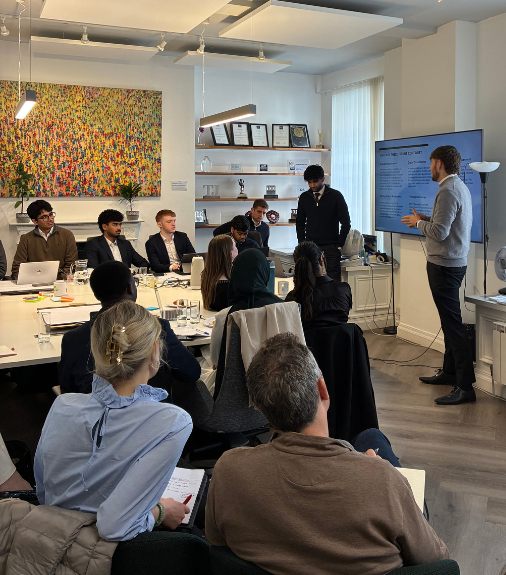
The Q5 Futures Taskforce is an annual research programme that brings together university students from a range of disciplines to explore the emerging trends shaping the future of organisations. Working alongside our consultants and industry experts, participants combine academic research with practical insight to investigate the challenges businesses will face over the coming decade. As part of Q5’s wider research and development programme, the Taskforce’s findings help inform how organisations can respond to long-term change.
This year’s Q5 Futures Taskforce brought together students from universities across the UK to explore one of the defining organisational challenges of the next decade: how businesses and institutions can successfully lead increasingly multigenerational workforces.
Across Financial & Professional Services, Public & Not-for-Profit, Infrastructure, Retail & Hospitality, and Media, students examined how organisations are responding to changing workforce expectations, ageing expertise, technological disruption, and evolving ideas around progression, flexibility and leadership.
Working alongside Q5 consultants and sector experts, each group carried out a combination of primary and secondary qualitative research to investigate the opportunities and tensions created by five generations increasingly working side-by-side.
To ground our own research in broader quantitative analysis, we have partnered with Ipsos who have recently published their annual ‘Generations at Work report, analysing global employee experience benchmarking data, including over 3.6 million responses from employees aged 16 to 66+ across industries, roles and regions.
What did we find? Whilst each sector faced distinct challenges, several themes emerged consistently throughout the programme: leadership quality matters more than generational stereotypes; knowledge transfer is becoming a strategic capability; and organisations can no longer rely on collaboration across generations happening naturally.
Read our findings below:
Q5’s Futures Taskforce 2026 explored these topics across Financial and Professional Services, Public and Not-for-Profit, Infrastructure, Retail and Hospitality, and Media. Across each sector, one message came through clearly: multigenerational working is not primarily a people problem. It is an organisational design challenge. Leadership quality matters more than generational stereotypes. Knowledge transfer is becoming a strategic capability. Collaboration across generations cannot be left to happen naturally.
Ipsos’ Generations Report 2026 comes to a similar conclusion. Its workplace analysis argues that many differences at work are not simple generational divides, but patterns of progression, pressure and stability as careers develop. It notes that perceived disruption often reflects life stage and career stage effects rather than fixed generational traits.
That distinction matters. If organisations over-focus on generational labels, they risk designing interventions around stereotypes. If they look instead at work, careers, leadership and life stages, they can start to build healthier, more resilient organisations.
From labels to operating model choices
It is easy to talk about generations in shorthand: Gen Z are digital natives; millennials want flexibility; Gen X are pragmatic and stretched; boomers hold institutional memory. There may be useful patterns in some of these observations, but they are not enough to design an organisation around.
Our Futures Taskforce research found that workplace behaviour is shaped far more by leadership quality, organisational culture and psychological safety than by age itself. In Financial and Professional Services, for example, the Taskforce found that while generations may bring different ethical expectations or experiences of crisis, risk culture depends more on leadership, challenge culture and psychological safety than on demographic category.
Ipsos’ report warns against persistent stereotypes and the temptation to explain behaviour through generational labels alone. It asks whether people are showing “dreadful new behaviours”, or whether they are simply moving through familiar life stages under different conditions.
For leaders, this creates a practical challenge. It is not enough to ask, “How do we manage Gen Z?” or “How do we retain older workers?” Better questions are:
Are our leadership behaviours inclusive across age and life stage?
Are our systems designed to transfer knowledge before it is lost?
Are our career models still based on assumptions that no longer hold?
Are we measuring productivity by value, or by visibility?
Are we creating flexibility that is fair in practice, not just equal in policy?
These are are operating model choices, rather than communications issues.
Leadership matters more than generation
One of the clearest findings from the Futures Taskforce was that leadership quality is a stronger predictor of organisational outcomes than workforce age profile. Across all sectors, psychological safety, escalation culture and inclusive leadership mattered more than generational stereotypes.
This is especially important because multigenerational workforces can surface tensions that already exist in the system. A debate about hybrid working may actually be a debate about trust. A complaint about younger workers lacking resilience may be a sign of unclear expectations, workload pressure or weak management. A perception that older employees resist change may point to a failure to value experience or involve people properly in transformation.
Ipsos’ workplace findings support this more nuanced view. Its report identifies themes where there is little variation between age bands, including psychological safety, inclusive culture, strategic clarity, pride, recognition and the ability to be oneself. These are not generation-specific needs. They are fundamentals of organisational health.
The implication is clear. Organisations do not need a different leadership model for every generation. They need leaders who can create clarity, trust, inclusion and accountability for people at different stages of life and career.
A useful provocation for leaders is this: what would change if organisations stopped treating age diversity as a sensitivity issue and started treating it as a leadership capability?
Knowledge transfer is becoming strategic infrastructure
The Futures Taskforce found that knowledge transfer is no longer a nice-to-have. It is becoming a strategic priority, especially where organisations depend on tacit knowledge, judgement and institutional memory.
This was most visible in the Infrastructure research. In sectors such as nuclear, construction and aerospace, retiring subject matter experts hold knowledge that is often undocumented and difficult to replace. At the same time, younger workers may leave because progression pathways are unclear and organisational structures feel slow-moving. The Taskforce conclusion was direct: workforce capability and knowledge transfer should be treated as core operational infrastructure, not simply HR activity.
The same logic appeared in Financial and Professional Services. The research identified a natural “risk chain” across generations: junior employees are often closest to real-time signals, mid-career professionals translate and escalate issues, and senior leaders hold sign-off authority and institutional memory. Mixed-age teams strengthen resilience only when knowledge transfer and challenge culture are deliberately designed into the organisation.
Ipsos adds useful context here. Its findings point to longer lives, later life stages and a growing post-retirement population. It notes that by 2050, the United Nations predicts the number of people aged 60 or over will double to over 2.1 billion, around 26% of the global population.
For organisations, this is both a demographic fact and workforce design issue. Longer lives mean longer, less linear careers. Experienced people may want to step up, step back, mentor, consult, work flexibly, build portfolio careers or contribute through alumni networks. Treating retirement as a hard stop risks losing capability that could continue to create value in different forms.
This becomes even more important in the age of AI. As technology becomes embedded in more roles, organisations will need to distinguish between knowledge that can be automated and judgement that cannot. AI may accelerate analysis, but human judgement, contextual understanding, ethical reasoning, trust and pattern recognition will still need to be developed through experience.
The practical question is not simply “How do we keep older workers for longer?” It is “How do we create the conditions for experience to keep creating value?”
That means moving from informal goodwill to deliberate design. Mentoring, reverse mentoring, succession planning, communities of practice, phased retirement, expert advisory roles, alumni networks and structured handovers can all help. But they need to be built into the operating model, not added as side initiatives.
Flexibility is expected, but not equally experienced
The Futures Taskforce found that flexibility is expected, but it shows up differently across generations. Younger workers increasingly expect visible progression, autonomy and flexibility, while older workers may seek phased retirement and alternative contribution pathways. One-size-fits-all career models are becoming less sustainable.
This is not just about working from home. It is about how careers, roles and contribution are structured.
In the Public and Not-for-Profit research, the Taskforce found that workforce challenges were less about motivation and more about the conditions in which staff work. Younger cohorts reported strong motivation but low autonomy and limited visibility of progression. The recommendation was for more flexible career pathways, stronger onboarding, better mentoring and improved workforce data segmentation.
Ipsos’ workplace section describes the 26 to 35 age group as still engaged, but experiencing a dip in career outlook after the early “honeymoon period”. It also highlights that career development positivity continues to decline in older age bands.
This suggests a broader point: organisations should not assume that career support is mainly an early-career issue. Different groups need different forms of momentum. Early-career employees may need onboarding, belonging, progression visibility and confidence. Mid-career employees may need clearer priorities, manageable workload and support with competing responsibilities. Later-career employees may need respect, renewed contribution, communication, development and flexible pathways.
The linear career ladder is no longer enough. Organisations need career models that allow people to grow, pause, shift, mentor, specialise, return and contribute in different ways over time.
A useful leadership question is: what would careers look like if they were designed around contribution, not just progression?
Productivity, visibility and fairness
One of the most live tensions in multigenerational workforces is the definition of “good work”.
Some people still associate productivity with presence, responsiveness, hours and visible effort. Others place more emphasis on outputs, autonomy and outcomes. Neither view is automatically right or wrong. The problem comes when organisations leave the definition implicit.
Q5’s multigenerational research has highlighted this tension directly: different groups may hold different assumptions about productivity, which can create misalignment in how performance is judged. The risk is that organisations claim to be outcome-led while still rewarding availability, speed of response and visibility.
The critical question for leaders is how to move from judging productivity by visibility to judging it by value, while still maintaining trust, collaboration and accountability.
Ipsos’ report adds a useful perspective. Its workplace analysis shows that the 36 to 45 age group is most likely to report doing things that contradict their stated work preferences, including responding to emails or calls outside working hours, performing tasks outside their role and feeling under constant strain.
That should give leaders pause. The people often seen as capable, established and able to absorb complexity may also be carrying a disproportionate amount of friction in the system. If these employees are also managing teams, they shape the culture experienced by those beneath them.
Fairness is the harder part. Flexibility cannot simply mean the same policy for everyone. Roles differ. Customer needs differ. Life stages differ. Some work can be done remotely, some cannot. Some people have the confidence and security to use flexibility, while others may worry it will affect progression.
The task for leaders is to be explicit. What outcomes matter? Where is presence valuable? Where is autonomy possible? What are the trade-offs? How will decisions be made consistently? What support do managers need to apply flexibility fairly? Without that clarity, flexibility can become another source of tension.
Age inclusion is a business capability
The Futures Taskforce Retail and Hospitality research in particular demonstrated that age inclusion should increasingly be treated as a strategic business capability rather than simply a diversity initiative. The strongest organisations intentionally create age-inclusive cultures through flexible career pathways, cross-generational collaboration and tailored learning approaches.
This is a useful reframing. Age inclusion is not just about making people feel welcome, although that matters. It is about performance. Different generations may bring different strengths: digital fluency, customer understanding, experience, judgement, networks, creativity, resilience and institutional memory.
The Media sector research made this particularly clear. Generational difference can improve innovation, credibility and audience relevance when it is harnessed deliberately. Organisations perform best when they intentionally combine the experience and judgement of senior employees with the platform fluency and audience understanding of younger colleagues.
Interestingly, according to Ipsos, 26 to 35-year-olds are perceived as most likely to be at ease with AI and digital tools, as well as innovative. But the report also challenges simplistic narratives across age bands, showing that needs such as recognition, psychological safety, inclusive culture and clarity are shared.
The point is not to deny difference but to prevent it being reductive. Age inclusion should therefore be designed through the work itself: who gets heard in decisions, who has access to development, how knowledge moves, how teams are composed, how leaders value different forms of contribution, and how career pathways support people at different stages.
Belonging matters here, but it should not be understood only as social connection. People need to feel they belong as contributors to the future of the organisation. That means their experience, ideas, challenge and ambition are recognised as relevant.
A word about AI…
AI raises the stakes and adds urgency to all of this. As technology reshapes work, organisations need to distinguish between knowledge that can be automated, tasks that can be augmented and judgement that remains deeply human.
The answer is likely to be a combination. AI may change how work is done, but it also increases the value of human judgement, contextual understanding, ethical reasoning, client trust and critical thinking. These capabilities are often developed over time, through exposure, reflection, challenge and experience.
That makes intergenerational learning more important, not less. Younger colleagues may bring fluency with emerging tools and platforms. More experienced colleagues may bring judgement, pattern recognition, client understanding and institutional memory. Mid-career colleagues often translate between strategic intent and operational reality.
The danger is that organisations automate tasks without designing how people will continue to develop judgement. If early-career employees no longer do the work that historically helped them learn, organisations will need new ways to build capability. Reverse mentoring alone will not be enough. Nor will traditional top-down knowledge transfer.
The future model needs to be reciprocal. Experience and innovation need to move in both directions.
What organisations should do now
The Q5 Futures Taskforce research points to a practical conclusion: multigenerational workforces are an advantage to being resilient, but only when organisations build the conditions to harness them. Mixed-age teams can improve adaptability, problem-solving, customer understanding and organisational resilience. The challenge is not diversity itself, but whether the organisation is designed to make use of it.
For leaders, five actions stand out.
- First, start with the work, not the stereotype. Use age and life-stage data as context, not labels. Look at where different groups experience friction, blocked progression, low autonomy, poor communication or weak belonging.
- Second, build knowledge transfer into the operating model. Treat mentoring, succession, expert contribution and alumni engagement as strategic infrastructure, particularly in areas where tacit knowledge is hard to replace.
- Third, redesign career pathways for longer working lives. Create options for stepping up, stepping across, stepping back, mentoring, specialising, returning and contributing flexibly.
- Fourth, equip managers to lead across life stages. Managers need principles, not just policies. They need to manage performance by value, apply flexibility fairly, support development and create psychological safety.
- Fifth, make age inclusion part of organisational health. This means looking at leadership, culture, work design, communication, progression and belonging together.
The organisations that do this well will not be those with the most polished generational awareness training. They will be those that design systems, cultures and leadership practices that help people at different stages of life and career contribute to shared outcomes.
The real opportunity
The future workforce is not simply about younger workers replacing older workers. Nor is it about retaining older employees while attracting younger ones. It is about building organisations that can combine experience, adaptability, institutional knowledge and innovation into a more resilient whole.
That is the central message from Q5’s Futures Taskforce. Generations matter, but they are only part of the picture. Life stage, career stage, culture, context and leadership all shape how people experience work.
Not every generation needs the same thing. But every generation needs clarity, respect, development, inclusion and meaningful work.
That is where multigenerational workforces become a source of organisational health, resilience and performance.

 by
by