Unlocking potential, allocating resources in the right way and driving accountability without burning people out
Many organisations are caught between relentless performance pressure and cultures that lack accountability. The organisations that thrive will build collective performance, align leadership teams, allocate talent strategically and create disciplined execution through clearer priorities, stronger capability and more sustainable ways of working.
Reading time: 11 minutes
There is a tension sitting at the heart of most organisations undergoing significant change.
Boards want growth, transformation and productivity gains. Leaders are asked to reduce cost, simplify structures and deliver more with less. Employees, meanwhile, are navigating constant change, increasing complexity and the growing reality of AI and automation reshaping work altogether.
The result? Many organisations are trapped between two unhelpful extremes. On one side, cultures that over-index on performance and create exhaustion, dependency on a heroic few and unsustainable pressure. On the other, cultures that talk endlessly about wellbeing and engagement but struggle to generate momentum, ownership or accountability.
The organisations that will thrive over the next decade will resolve this tension differently. They will:
- Build collective rather than heroic performance
- Create aligned, psychologically safe leadership teams
- Allocate talent and capability strategically, not reactively
- Drive focus and accountability through disciplined execution
Together, these form the foundations of resilient organisational performance.
Peak Performance is collective, not individual
For years, organisations have unintentionally romanticised the “hero employee”: the person who consistently over-delivers, works at unsustainable pace and becomes indispensable to delivery.
The problem is that heroic performance rarely scales, and even more rarely sustains. In addition, over-celebrating heroic performance can unintentionally drive individualism, internal competition and credit-seeking, when the best organisational outcomes are usually achieved through collaboration, shared ownership and collective success.
Increasingly, research points to a different truth: peak organisational performance is collective, not individual. Culture Amp’s global research across 1,800 organisations found that only 2% of employees sustained individual high performance over consecutive performance cycles. Organisational performance, however, proved far more durable when the right collective conditions existed.
Their research identified what they call “Peak Performance cultures”, organisations where employees are both highly engaged and confident in the organisation’s direction and ability to execute. These organisations demonstrated materially stronger business outcomes, including a 47% stock-price performance advantage over two years and significantly stronger retention.
What matters here is the shift away from viewing engagement and performance as separate conversations. Organisations perform best when employee energy, strategic clarity and confidence in leadership operate as a coherent system.
This has important implications for leaders. Over-reliance on exceptional individuals creates bottlenecks, concentrates tacit knowledge and weakens resilience when key talent exits. Sustainable performance comes from raising the performance bar across the whole system: creating clarity, investing in capability and ensuring recovery, focus and energy are treated as operational priorities, not “soft” concerns.
The lesson for leaders?
Sustainable performance should not depend on extraordinary effort from a few people. The strongest organisations build capabilities and systems where many people can perform consistently well together.
Leadership teams: The culture multiplier we don’t talk about enough
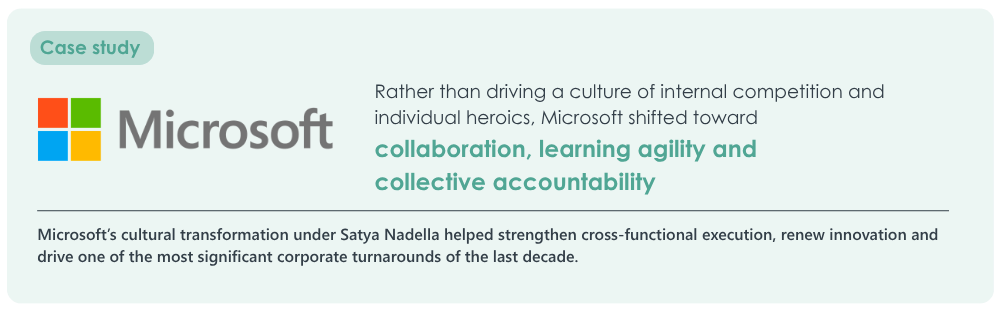
When leadership teams operate with low trust, poor communication or unresolved tension, the dysfunction cascades quickly through the organisation. Priorities become confused, decision-making slows and employees default to self-protection rather than collaboration.
This is where psychological safety matters. The absence of psychological safety is costly. Leadership teams that avoid conflict often create far more destructive conflict beneath the surface: duplication, politics, silos and passive resistance. Employees spend energy navigating personalities and ambiguity instead of solving problems.
Strong leadership teams create clarity, consistency and emotional steadiness during uncertainty. They role model accountability without blame, challenge without ego and alignment without groupthink. Furthermore, innovation and breakthroughs happen when people feel safe to experiment, challenge ideas and take intelligent risks without fear of blame or failure.
And increasingly, in environments shaped by constant change and AI disruption, this matters more than ever. Employees do not expect leaders to have all the answers. But they do expect coherence, honesty and consistency.
The lesson for leaders?
Employees experience culture not only by what leaders say but also through the behaviour of leadership teams. If senior leaders are misaligned, unclear or avoid difficult conversations, the rest of the organisation will feel it. Demonstrating vulnerability in leadership is a courageous act.
Strategic Workforce Planning: Moving from reactive resourcing to proactive capability building
At its core, SWP is about proactively anticipating future workforce requirements based on both strategic direction and external market dynamics, typically over a three-to-five-year horizon. The objective is not simply cost optimisation. It is ensuring the organisation has the right roles, capabilities and capacity to deliver strategy sustainably within the realities of cost, risk and changing market conditions.
Effective SWP requires organisations to prepare properly before jumping into planning activity. That means having a clearly defined strategy, understanding future market headwinds, building a realistic view of technological disruption and ensuring sufficient workforce data exists to make informed decisions.
This matters now more than ever because AI and automation are fundamentally changing workforce economics. Increasingly, organisations need to critically define the work humans should uniquely do, while building the right skills, safeguards and decision-making frameworks that enable employees to leverage AI and other technologies effectively.
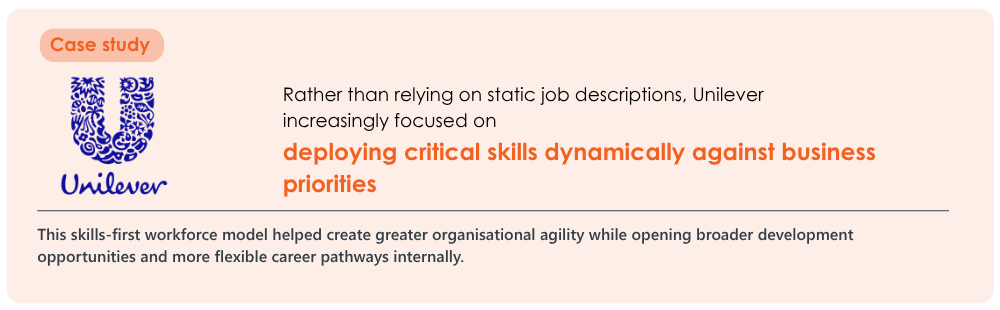
Organisations that approach workforce planning strategically are already making sharper decisions about where to automate, where to upskill, where to redeploy talent and where specialist expertise creates competitive advantage.
Done well, SWP also reduces burnout risk. One of the hidden drivers of organisational fatigue is chronic misalignment between strategic ambition and workforce capacity. When organisations continuously layer priorities onto already stretched teams without redesigning capability or resourcing models, exhaustion becomes inevitable.
The lesson for leaders?
It’s not always a performance problem. Sometimes it’s a prioritisation and capacity problem. Building sustainable growth and organisational resilience requires honest trade-offs about where talent, time and investment are really needed.
OKRs: Setting choiceful, intentional strategic objectives & actions to create focus, ownership and momentum
Even when organisations clarify their strategy and invest in the right capabilities, another challenge often emerges: execution drift.
Priorities multiply. Teams become overwhelmed by competing demands. Activity increases, but strategic progress slows. Leaders talk about accountability, yet employees struggle to connect day-to-day work to broader organisational goals.
OKRs (Objectives and Key Results) can be a useful framework to tangibly convert strategy into day-to-day action. And yet, despite their popularity, OKRs are often misunderstood. Too frequently they become another reporting framework, another governance process or simply a more sophisticated to-do list.
Done properly, however, OKRs can become an effective mechanism for creating organisational alignment, accountability and enduring direction without resorting to micromanagement.
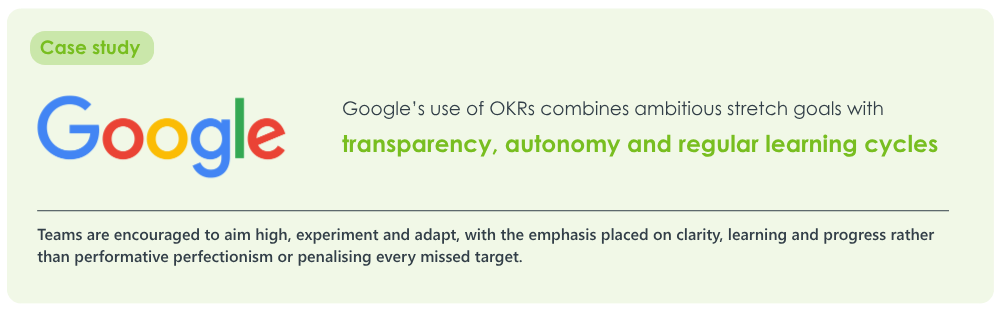
The core principle behind OKRs is deceptively simple: create absolute clarity on what matters most, define measurable outcomes that indicate progress, and empower teams to determine how best to achieve them. The framework connects organisational purpose to practical execution rhythms.
There’s an important distinction to be made between OKRs and traditional KPIs. KPIs often measure operational performance and outputs. OKRs are designed to drive change, innovation and strategic movement, particularly in environments where outcomes are uncertain, transformation is occurring rapidly and organisations need adaptability alongside accountability.
Critically, effective OKRs require ruthless prioritisation. One of the most important leadership capabilities in high-performing organisations is the ability to say “not now”. Without this discipline, organisations unintentionally create overload by treating every initiative as equally urgent.
This is where OKRs become deeply connected to organisational wellbeing. Contrary to popular belief, accountability itself does not create burnout. Ambiguity does. Constantly shifting priorities do. Misaligned incentives do. Lack of clarity does.
The OKR framework can reinforce collective accountability and learning by creating shared ownership, enabling teams to review progress, adapt priorities dynamically and enable faster decision-making closer to the work itself. Perhaps most importantly, OKRs bridge the gap between strategy and execution by translating broad ambition into visible, measurable progress.
And in an environment where many employees can feel disconnected from organisational direction, that visibility matters enormously.
The lesson for leaders?
People rarely burn out from meaningful progress. They burn out from running hard without clarity on what matters, what success looks like or where to focus their energy.
The future of performance is smarter, not harder
The organisations that will outperform over the next decade will not necessarily be the ones with the biggest workforces, the longest hours or the loudest wellbeing agendas. They will be the organisations that create clarity, the ones that build collective capability and the ones that allocate talent intentionally against future strategic priorities rather than historical structures.
This requires leaders to ask harder questions:
- Are we investing in the capabilities that matter most for the future?
- Are our people clear on what truly matters?
- Are we rewarding activity or meaningful progress?
- And are we creating the conditions for sustained performance, or simply surviving on borrowed energy?
High-performing organisations are rarely accidental.
They are designed.
How Q5 can help:
- Build Collective Performance: We help organisations identify and remove the leadership, capability and cultural barriers preventing sustainable high performance at scale.
- Improve Leadership Team Effectiveness: Strengthen executive team alignment, psychological safety and decision-making to create clearer, faster and more cohesive organisational leadership.
- Strategic Workforce Planning: Align workforce capability, capacity and investment to future strategic priorities, ensuring organisations have the right skills in the right places at the right time.
- Strategy Activation & Implementation: Translate strategy into focused execution by improving prioritisation, accountability and organisational alignment through practical strategy implementation tools and support
If this is something your organisation is grappling with, we’d love to start a conversation.

Olivia Taylor
Principal Consultant | Organisational Psychologist
[email protected]

 by
by