How leaders can create and deliver ‘immersive’ strategy that people can actually see themselves in
Successful strategy execution depends not only on the quality of the strategy itself, but on leadership’s ability to build belief, trust and organisational alignment. This article explores how leaders can make strategy truly land by shaping culture, modelling consistent behaviours and creating systems that enable execution, supported by real-world business examples and research.
Reading time: 5 minutes
Does this sound familiar?
- You’re taking your organisation into new markets, reaching new customers, setting a bold direction
- You’re evolving – reshaping your portfolio and capabilities, balancing today’s performance with tomorrow’s growth
- You’re responding to disruption – AI, automation, and shifting competitive dynamics
- You’re consolidating assets under pressure to deliver value, faster
In these scenarios, we’re assuming the strategic work has been set. The thinking is rigorous. The options have been tested and the trade-offs debated.
Whatever the scenario that has prompted a strategic shift or design, there is often a quieter question that can go unasked…
What will it take, in leadership terms, for this to actually land?
Strategy is still, fundamentally human. Leaders are asking people to move towards something uncertain, often uncomfortable, and rarely fully defined.
That requires more than logic. It requires connection.
- People need to understand the strategy
- They also need to believe in it
- And they need to believe in the people asking them to deliver it
This is where strategy meets culture. And where leadership behaviour becomes decisive.
Making strategy land: three things that matter
For strategy to be felt, not just heard, leaders need to be deliberate about three things.
Building belief in the strategy itself
A strategy doesn’t solely land because it is well written.
It lands when leaders bring the strategy to life consistently and convincingly in their messaging and communication, so that it becomes well understood, trusted, seen as credible and core to how the organisation operates.
That means going beyond describing what will happen, and being explicit about:
- the priorities
- the trade-offs
- where investment is, and isn’t being made
It also means painting a future that is both rational and compelling. Not just analytically sound, but something people can see themselves contributing to.
And importantly, it requires honesty. About uncertainty. About risk. About what may not go to plan.
Because credibility is built as much through what leaders acknowledge as what they assert.
There is good evidence for this. Research published in the Journal of Strategy and Management (2021) found that organisations where employees clearly understood strategic priorities and trade-offs were 2.5 times more likely to achieve successful execution outcomes than those where strategy remained abstract or ambiguous. This justifies the argument that leaders who spend extra time upfront building collective alignment on the strategy will deliver better results in the long run.
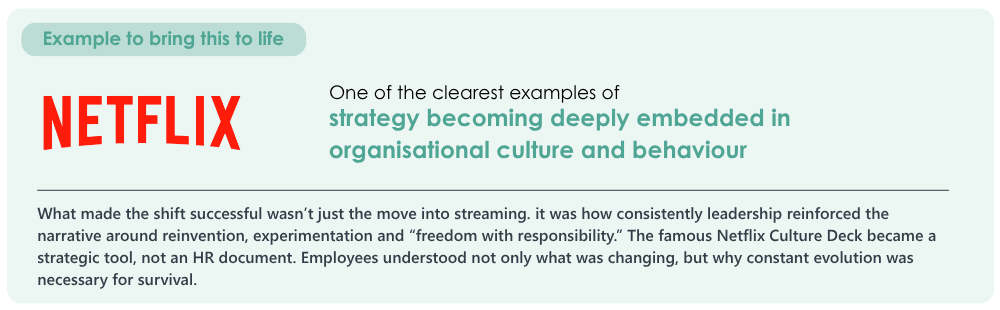
Example to bring this to life:
Building belief in leadership
Strategy implementation is a test of leadership behaviour under pressure.
- Can leaders hold their nerve when results take time?
- Can they make difficult trade-offs consistently?
- Can they balance empathy with accountability?
These aren’t soft skills. They are execution capabilities.
Recent research in The Leadership Quarterly (2022) highlights that organisations with high levels of perceived leadership authenticity and emotional intelligence see up to a 30% increase in employee commitment to strategic change initiatives.
In practice, this means leadership teams need to be honest with themselves.
- Where are we strong?
- Where are we inconsistent?
- Where might our behaviour undermine our intent?
The most effective teams are those who actively close that gap, who treat leadership behaviour as something to be designed and developed, not assumed.
People don’t just follow strategy.
They follow leaders.
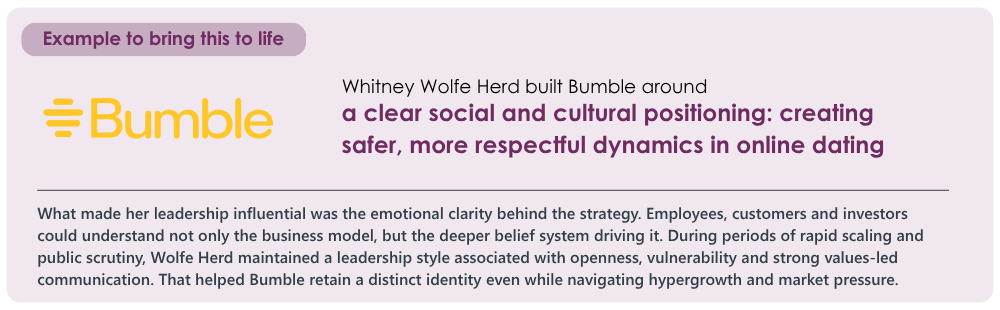
Example to bring this to life:
Building an organisational system that enables, not hinders
Strategy implementation will only be as good as the environment and systems that supports it. We see strategy fail in:
- Structures that slow decisions
- Incentives that reward the wrong behaviours
- Processes that reinforce legacy ways of working rather than enable the future
We recommend that leaders need to ask a different set of questions:
- What does this strategy require from our organisation to succeed?
- What needs to start, stop, change or continue?
And then crucially…are we willing to act on the answers?
Research in the International Journal of Productivity and Performance Management (2023) shows that organisations with strong alignment between strategy, structure and operational systems are over 60% more likely to deliver intended performance outcomes.
When the system supports the strategy, execution can accelerate.
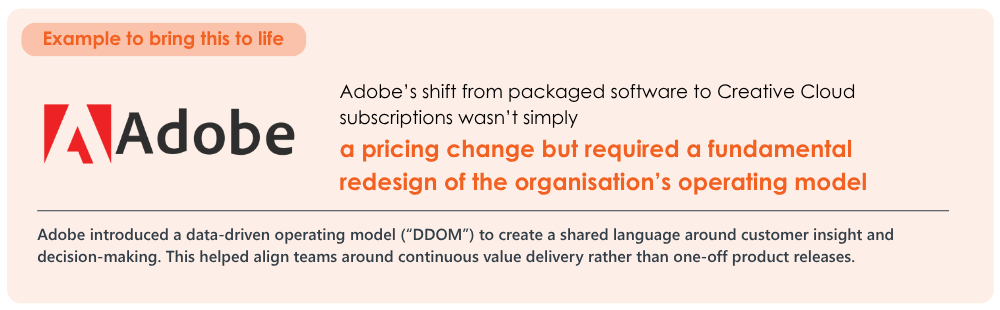
Example to bring this to life:
A final reflection
These questions sit squarely with leadership.
And while it can feel demanding, it doesn’t always require building something entirely new. Often, it’s about unlocking what already exists; resourcefulness, resilience, adaptability.
We saw that clearly during the pandemic.
The question now is whether leaders can create the conditions where that same energy can be directed towards strategy – deliberately, not reactively.
When strategy is truly felt, people don’t need convincing, rationale for decisions becomes clearer and momentum builds.
If any of this resonates, we would welcome a conversation:

Joel Grundy
Associate Partner | Head of Strategy
[email protected]

Alice Hughes
Senior Principal Consultant | Strategy
[email protected]

Olivia Taylor
Principal Consultant | Organisational Psychologist
[email protected]

 by
by