The Manufacturing and Engineering skills crunch: why hiring and AI alone won’t fix it – and what to do instead
Manufacturers and Engineers face a growing skills crunch that hiring and technology alone won’t solve. Leading organisations treat skills as an operating model, not an initiative. By redesigning roles, building coaching capacity, and linking learning to performance, manufacturers can create and sustain critical skills. Read more to learn six practical moves leaders can make now.
Reading time: 7 minutes
Manufacturing and Engineering leaders are facing a hard truth: the biggest constraint on performance isn’t always capex, demand, or even AI and technology investment – it’s capability and skills.
Yes, automation is accelerating. Yes, digital is reshaping how work gets done. But across the sector we see the same pattern: delivery slows because organisations can’t deploy, or sustain, the skills needed on the front line, in engineering, in maintenance, and in operational leadership.
Skills are now the bottleneck in manufacturing and engineering.
Make UK describes a “perfect storm” hitting the sector: early retirement, an ageing workforce, elevated occupational ill-health, plus apprenticeship starts are down sharply since the Levy was introduced several years ago. The result is simple: skill demand is rising at the same time the pipeline is shrinking.[1]
Our point of view: this isn’t primarily a talent acquisition problem, or a training catalogue problem. What’s needed is a capability-first operating model: designed to create, deploy and renew skills at pace – while protecting the health, engagement and longevity of the workforce you already have.
The capability ‘trap’ many manufacturers and engineers fall into
In too many organisations, capability building competes with “real work” and loses.
A familiar pattern shows up on sites and in plants:
- Training time is the first thing cut when output pressure spikes.
- Experts become the bottleneck, trapped in firefighting instead of coaching and knowledge transfer.
- Roles are over-specialised (or poorly defined), making cover difficult and development slow.
- Decisions and interfaces are unclear, creating rework and handoffs that waste scarce technical capacity.
- Transformation lands as skill shock: new tech and processes arrive faster than roles, pathways, and leadership routines adapt.
This is why upskilling efforts often feel busy… but don’t change the underlying system.
What “good” already looks like in leading manufacturers and engineers
In our experience, the manufacturers and engineers that make progress don’t just “invest in skills”. They redesign how skills are produced and sustained – end-to-end, from strategy to shop floor.
Examples of initiatives manufacturers and engineers are implementing include:
- A multinational digital technology manufacturer – treats skills development and continuous learning as a multi-year transformation programme, not as one-off HR initiative, including:
- strategic planning to identify skill needs based on bottom-up analysis of HRIS training data combined with top-down market trends
- building learning into role design, not just ‘bolted on,’ with sustained investment in short, digital on-demand learning cycles
- leadership role modelling with 50+ learning hours per year for all employees includes all senior leaders, transparently reported and tracked
- A UK based car manufacturer – invests in the future talent ecosystem early through:
- co-designing ups-killing pathways with universities where curriculum maps learning to real jobs
- adopting apprenticeship programmes as a strategic talent pipeline for growth, enabling apprentices to progress into senior and specialist roles
- A global car manufacturer – embeds capability-building into production itself through:
- on-the-job development from day one and an expectation of multi-skilling to increase operational flexibility over the long term
- setting up digital learning hubs and ‘training dojos’ next to production lines, where workers practise in simulation-first environments.
Each treat skills as an operating system, not an initiative.
The reset: a capability-first operating model
When skills become the constraint, the response needs to be structural, not just programmatic.
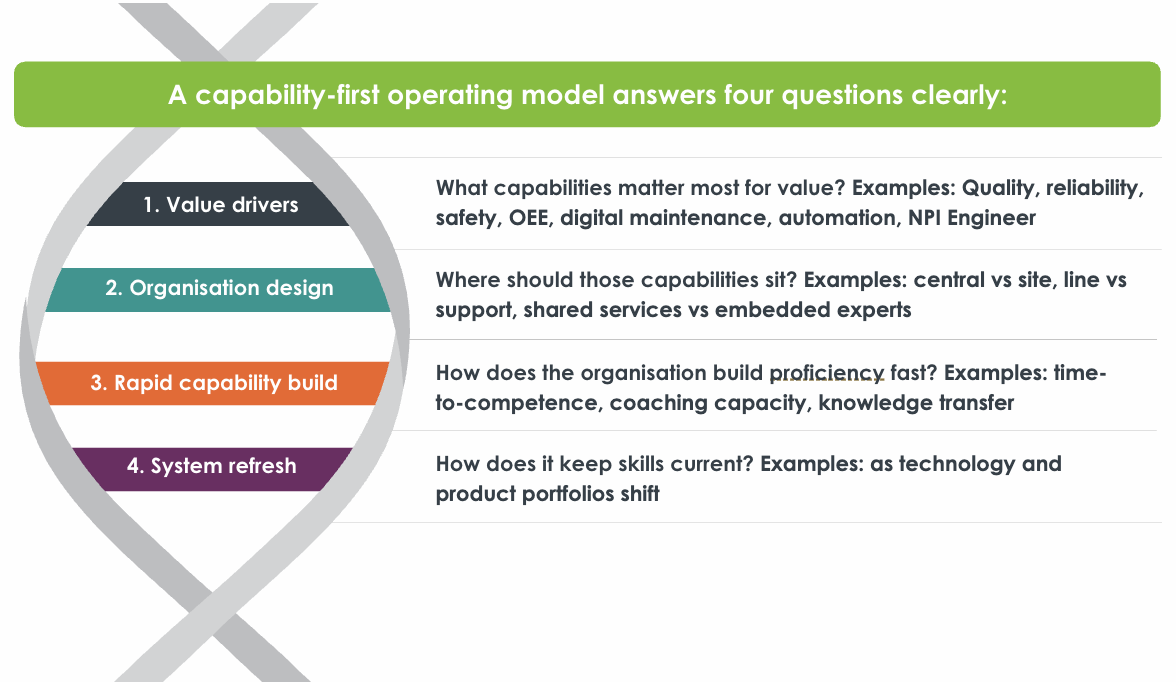
A capability-first operating model answers four questions clearly:
- What capabilities matter most for creating value (quality, reliability, safety, OEE, digital maintenance, automation, NPI)?
- Where should those capabilities sit (central vs site, line vs support, shared services vs embedded experts)?
- How does the organisation build proficiency fast (time-to-competence, coaching capacity, knowledge transfer)?
- How does it keep skills current as technology and product portfolios shift?
Six practical moves manufacturers and engineers can make now
These are the moves we see making the biggest difference, because they change the day-to-day system that produces capability:
- Map capability to value (not org charts)
Identify the few capabilities that truly drive performance and resilience, then make trade-offs explicit: where do you need deep mastery, and where do you need broad multi-skilling?
- Redesign roles around outcomes, not task lists
Clear outcomes, clean interfaces, and fewer handoffs reduce skill waste and make development pathways coherent.
- Build the “coaching spine” into the line
If team leaders/supervisors don’t have time and expectations to coach, learning doesn’t stick. Protect this capacity like you protect maintenance planning.
- Create progression pathways that make staying attractive
Operator → technician → specialist → leader pathways, with visible accreditation and real development time, are retention strategies as much as talent strategies.
- Shift measurement from “training delivered” to “proficiency achieved”
Track time-to-competence, error rates, quality escapes, downtime drivers, and first-time-right, and link learning to real performance outcomes.
- Make transformation practical: prove it in pilots, then scale
New ways of working don’t embed through comms. They embed through walkthroughs, pilots, visual management and leader routines, then replication.
If capability is now your binding constraint, it’s time to redesign the system that produces it.
At Q5, we specialise in supporting organisations through exactly this kind of transformation. We work with clients to design their operating model underpinned by strategic workforce plans to create, deploy and renew skills and capabilities at pace, driving growth and performance.
If you’d like to explore what a capability-first organisation could look like in your context, we’d welcome a conversation.

Joe King
Senior Principal Consultant
[email protected]

John Okten
Partner
[email protected]

Tom Amos
Associate Partner | Defence, Nuclear & Industrials
[email protected]
Source notes
[1] Make UK, Industrial Strategy Skills Commission Report 2025 (perfect storm framing; 55,000 long-term vacancies; £6bn lost output; apprenticeship starts down 42%).

 by
by