From accessibility to belonging: lessons from the panel
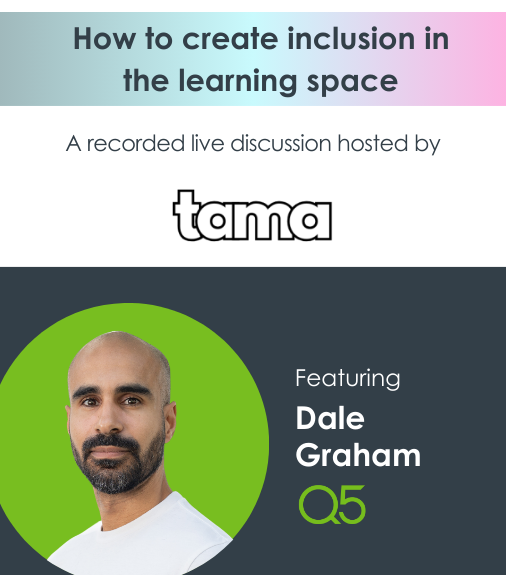
This summer, Tama Learning hosted “How to Create Inclusion in the Learning Space”, a panel featuring Blanche Improv, Mindshift Empowerment, Saterman Connect, and Q5. Our own Dale Graham shared Q5’s perspective on empathy, fairness, and healthy organisational culture. Themes included neurodiversity, psychological safety, and the power of language. Listen to the full discussion below.
Reading time: 5 minutes
Tama Learning hosted a thought-provoking panel discussion titled “How to Create Inclusion in the Learning Space.” The virtual event, held on 21st July 2025, explored what it truly means to design learning environments where every individual feels included, respected, and able to thrive.
We were especially proud that Q5 was represented by Dale Graham, our Culture & Client Offering Lead. Dale brought rich experience in organisational health and cultural transformation, sharing why empathy, fairness, and psychological safety are at the heart of healthy organisations.
Dale was joined by fellow panellists:
- Lelda Kapsis – Blanche Improv
- Lucy Wilson – Mindshift Empowerment
- Josh Saterman – Saterman Connect
- Jess Rogers – Tama Learning (host & facilitator)
Listen to the full discussion below:
What the panel explored
The discussion focused on five themes shaping inclusive learning:
- Designing for Neurodiversity – ensuring learning spaces accommodate different needs.
- Inclusion before, during & after – planning, facilitation, and follow-up all matter.
- Psychological safety – people learn best when they feel safe to contribute.
- Inclusive content & language – words, stories, and materials must reflect diversity.
- Power dynamics & participation – leaders and facilitators should consciously create space for others.
Q5’s perspective – Dale Graham on Inclusion
Throughout the conversation, Dale emphasised that:
- Inclusion is not complicated – sometimes, it’s as simple as being a decent, empathetic human being.
- Psychological safety signals health – when people feel safe enough to be vulnerable, ask questions, or admit mistakes, inclusion is working.
- Power dynamics can’t be ignored – leaders must be aware of the space they occupy and actively make room for quieter voices.
- Culture is the foundation – healthy organisations are inclusive, collaborative, fair, engaging, and psychologically safe.
These insights resonate deeply with Q5’s mission: to help organisations become healthier, more successful, and better places to work.
Broader takeaways from the panel
- Humility: Inclusion begins with putting ego aside and staying open to feedback.
- Kindness & Compassion: Empathy is the foundation of excellence in learning spaces.
- Language Matters: The words we use shape culture and belonging.
- Individual Focus: Inclusion happens when we care for individuals, not just groups.
Final reflections from the panel
- “Inclusion is about the individual — how we care for each person, not just groups.” – Lelda Kapsis
- “Reflect on how you respond to feedback. Are you reacting with fight, flight, fawn, or freeze?” – Lucy Wilson
- “Language has power. Stay curious, stay humble, and keep learning.” – Josh Saterman
- “At its core, inclusion is about being a decent, empathetic human being.” – Dale Graham, Q5
- “Stay humble, seek feedback proactively, and design with inclusion at the heart.” – Jess Rogers
Why it matters
At Q5, we believe every organisation deserves a healthy culture, and inclusion is a non-negotiable part of that. This panel reinforced that creating inclusive learning spaces is not a one-time effort, but an ongoing practice of humility, empathy, and intentional design. If this topic is of interest to you, please do get in touch — we’d love to chat!

Dale Graham
[email protected]
Culture & Client Offering Lead