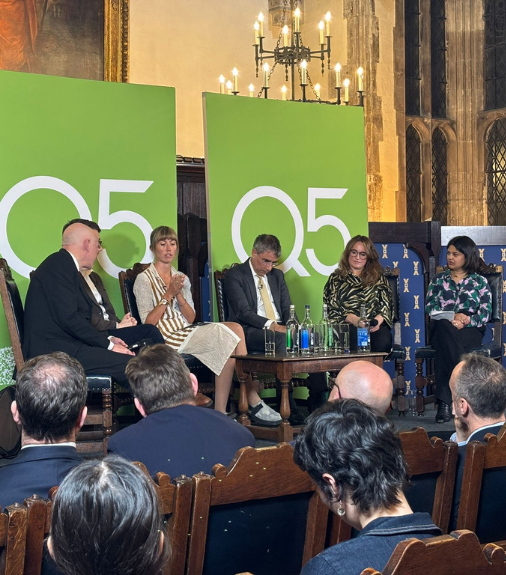
Q5 panel event: The nation’s ‘cash cow’
We recently convened a cross-sector panel to examine London’s role in the UK economy and the roots of anti-London sentiment. The discussion challenged zero-sum thinking, highlighted the impact of over-centralisation, and explored how stronger regional empowerment and collaboration could support more balanced, inclusive growth across the country. Listen to the podcast below.
Reading time: 2 minutes
We recently hosted a panel at The Old Hall, Lincoln’s Inn, bringing together leaders from across policy, business and academia. The discussion was facilitated by Dave Hill, Editor of On London and former Guardian London commentator, and featured Alexander Jan, Chief Economic Adviser at the London Property Alliance; Antonia Jennings, Chief Executive of the Centre for London; Hannah Buckley, Head of Q5 North; Dr Jack Brown, Senior Lecturer in Government Studies at King’s College London; and Muniya Barua, Deputy Chief Executive of BusinessLDN.
Watch the full discussion:
Key insights from the discussion include:
- London is economically vital to the UK, but the framing matters
The panel broadly agreed that London generates a major fiscal and economic surplus for the country, but several speakers argued that calling it a “cash cow” is unhelpful. A better framing is that London is an engine of growth whose success supports jobs, tax revenue, supply chains and investment across the UK.
- Anti-London sentiment is real, longstanding, and driven by multiple narratives
Hostility towards London is not new. The discussion traced it to centuries-old concerns about overconcentration, as well as modern political and media narratives portraying London as elitist, overfunded, unsafe or disconnected from the rest of the country. The panel stressed that this sentiment is often simplistic and ignores the city’s internal inequalities.
- London’s success and regional growth should not be treated as a zero-sum game
A core theme was that the UK should stop pitting London against other places. The strongest view from the panel was that London and the regions are economically interconnected. Growth in London can support growth elsewhere, but that depends on better transport, stronger regional clusters, and more deliberate ways of spreading the benefits of investment.
- The deeper national problem is over-centralisation, not London itself
Several speakers argued that the real issue is the UK’s highly centralised system of government and finance. Cities and regions have too little control over taxation, investment and infrastructure. Greater devolution, especially fiscal devolution, was presented as one of the most important ways to unlock growth, improve local decision-making, and reduce resentment.
- The way forward is better local control, stronger regional investment, and a more confident story about London
The panel concluded that London should be more confident in explaining its national and global role, while also acknowledging its own challenges such as housing, inequality and crime perceptions. At the same time, other UK cities and regions need the powers, infrastructure and long-term investment to build on their own strengths. The clearest takeaway was that giving places more control over their own futures could help reduce both inequality and anti-London feeling.
Prefer podcasts? Listen below: